current | resistivity | Current electricity | ohm law | electric current | physics

Image
Current electricity and ohm's law(Current electricity) :- •What is current? Rate of flow of electric charge with time through any cross section of a wire is called current. It is denoted by I . Thus if charge "dq" flows through a wire in small time "dt" then electric current through wire is given by :                                             I=dq/dt  1 ampere = 1coulomb/1 second  1A=C/s •Ampere :-                                                           The current Through a wire is called one ampere if one coulomb charge is flow through Any cross section of wire in one second   •Ohm's law:- Ohm’s principal discovery was that the amount of electric current through a metal conductor...

Electric potential (electrostatic) | electostatic | physics

•  Electric potential (Electrostatics)

An electric potential is the amount of work needed to move a unit of charge from a reference point to a specific point inside the field without producing an acceleration. Typically, the reference point is the Earth or a point at infinity, although any point can be used. 


Other units: statvolt
SI unit: volt
In SI base units: V = kg⋅m2⋅A−1⋅s−3
Common symbols: V
Dimension: M L2 T−3 I−1
Formula
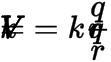
V = k \frac{q}{r}

V = electric potential
k = Coulomb constant
q = charge
r = distance of separation

Volt :---

   The electric potential at a point is said to be one volt, if one joule of work is done in moving a charge of one coulomb from infinity to that point against electrostatic force due to electric field. 


• Some  Board  Exam  level  Question  Answers :-


Q. 1) Define Electric potential Between two points ?

Ans:- An electric potential is the amount of work needed to move a unit of charge from a reference point to a specific point inside the field without producing an acceleration. Typically, the reference point is the Earth or a point at infinity, although any point can be used. 


Q. 2) The electric potential is constant in a region. What can you say about electric field there ?

Ans:- We know that  E = -dV/dr
         Thus, electric field is zero since V is constant  .


Q. 3) Is electrostatics potential necessarily zero at point where electric field strength is zero. 

Ans:- If E = 0, then E = -dV/dr = 0
        Because V is constant  and may not be zero  .


Q. 4) what is the SI unit of Electric potential  ?

Ans:- Volt (V). 


Ask me questions _
https://instagram.com/sachin_dreamboy?igshid=1nrvcyyt8v4z


Comments

Physics

Electric lines of force (electrostatic) | electostatic | physics

current | resistivity | Current electricity | ohm law | electric current | physics

Electric field (electrostatic) | electostatic | physics

State and prove the Gauss's Theorem (electrostatic) | electostatic | physics